
Request Processing
Once a Pyramid application is up and running, it is ready to accept requests and return responses.
What happens from the time a WSGI request enters a Pyramid application through to the point that Pyramid hands off a response back to WSGI for upstream processing?
- A user initiates a request from his browser to the hostname and port number of the WSGI server used by the Pyramid application.
- The WSGI server used by the Pyramid application passes
the WSGI environment to the
__call__method of the Pyramid router object. - A request object is created based on the WSGI environment.
- The application registry and the request object
created in the last step are pushed on to the thread local
stack that Pyramid uses to allow the functions named
get_current_request()andget_current_registry()to work. - A
NewRequestevent is sent to any subscribers. - If any route has been defined within application configuration, the Pyramid router calls a URL dispatch “route mapper.” The job of the mapper is to examine the request to determine whether any user-defined route matches the current WSGI environment. The router passes the request as an argument to the mapper.
- If any route matches, the request is mutated; a
matchdictandmatched_routeattributes are added to the request object; the former contains a dictionary representing the matched dynamic elements of the request’sPATH_INFOvalue, the latter contains theIRouteobject representing the route which matched. The root object associated with the route found is also generated: if the route configuration which matched has an associated afactoryargument, this factory is used to generate the root object, otherwise a default root factory is used. - If a route match was not found, and a
root_factoryargument was passed to the Configurator constructor, that callable is used to generate the root object. If theroot_factoryargument passed to the Configurator constructor wasNone, a default root factory is used to generate a root object. - The Pyramid router calls a “traverser” function with the
root object and the request. The traverser function attempts to
traverse the root object (using any existing
__getitem__on the root object and subobjects) to find a context. If the root object has no__getitem__method, the root itself is assumed to be the context. The exact traversal algorithm is described in Traversal. The traverser function returns a dictionary, which contains a context and a view name as well as other ancillary information. - The request is decorated with various names returned from the
traverser (such as
context,view_name, and so forth), so they can be accessed via e.g.request.contextwithin view code. - A
ContextFoundevent is sent to any subscribers. - Pyramid looks up a view callable using the context, the
request, and the view name. If a view callable doesn’t exist for this
combination of objects (based on the type of the context, the type of the
request, and the value of the view name, and any predicate
attributes applied to the view configuration), Pyramid raises a
HTTPNotFoundexception, which is meant to be caught by a surrounding exception view. - If a view callable was found, Pyramid attempts to call the view function.
- If an authorization policy is in use, and the view was protected
by a permission, Pyramid passes the context, the request,
and the view_name to a function which determines whether the view being
asked for can be executed by the requesting user, based on credential
information in the request and security information attached to the
context. If it returns
True, Pyramid calls the view callable to obtain a response. If it returnsFalse, it raises aHTTPForbiddenexception, which is meant to be called by a surrounding exception view. - If any exception was raised within a root factory, by
traversal, by a view callable or by Pyramid itself
(such as when it raises
HTTPNotFoundorHTTPForbidden), the router catches the exception, and attaches it to the request as theexceptionattribute. It then attempts to find a exception view for the exception that was caught. If it finds an exception view callable, that callable is called, and is presumed to generate a response. If an exception view that matches the exception cannot be found, the exception is reraised. - The following steps occur only when a response could be
successfully generated by a normal view callable or an
exception view callable. Pyramid will attempt to execute
any response callback functions attached via
add_response_callback(). ANewResponseevent is then sent to any subscribers. The response object’s__call__method is then used to generate a WSGI response. The response is sent back to the upstream WSGI server. - Pyramid will attempt to execute any finished
callback functions attached via
add_finished_callback(). - The thread local stack is popped.
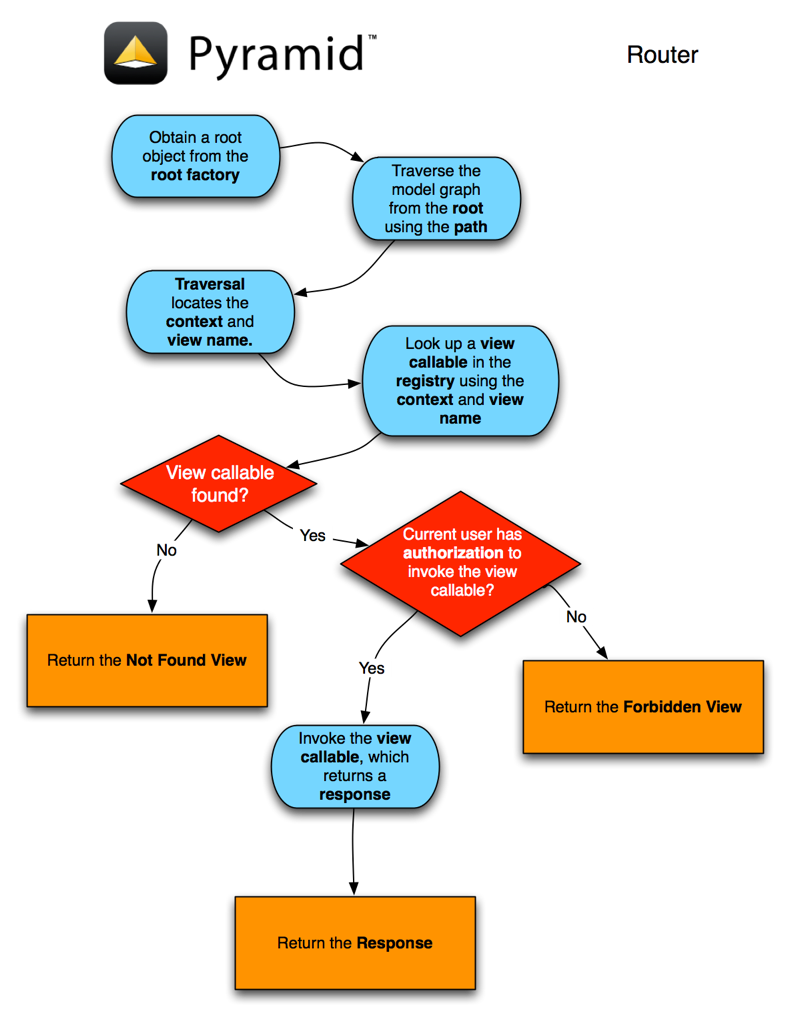
This is a very high-level overview that leaves out various details. For more detail about subsystems invoked by the Pyramid router such as traversal, URL dispatch, views, and event processing, see URL Dispatch, Views, and Using Events.